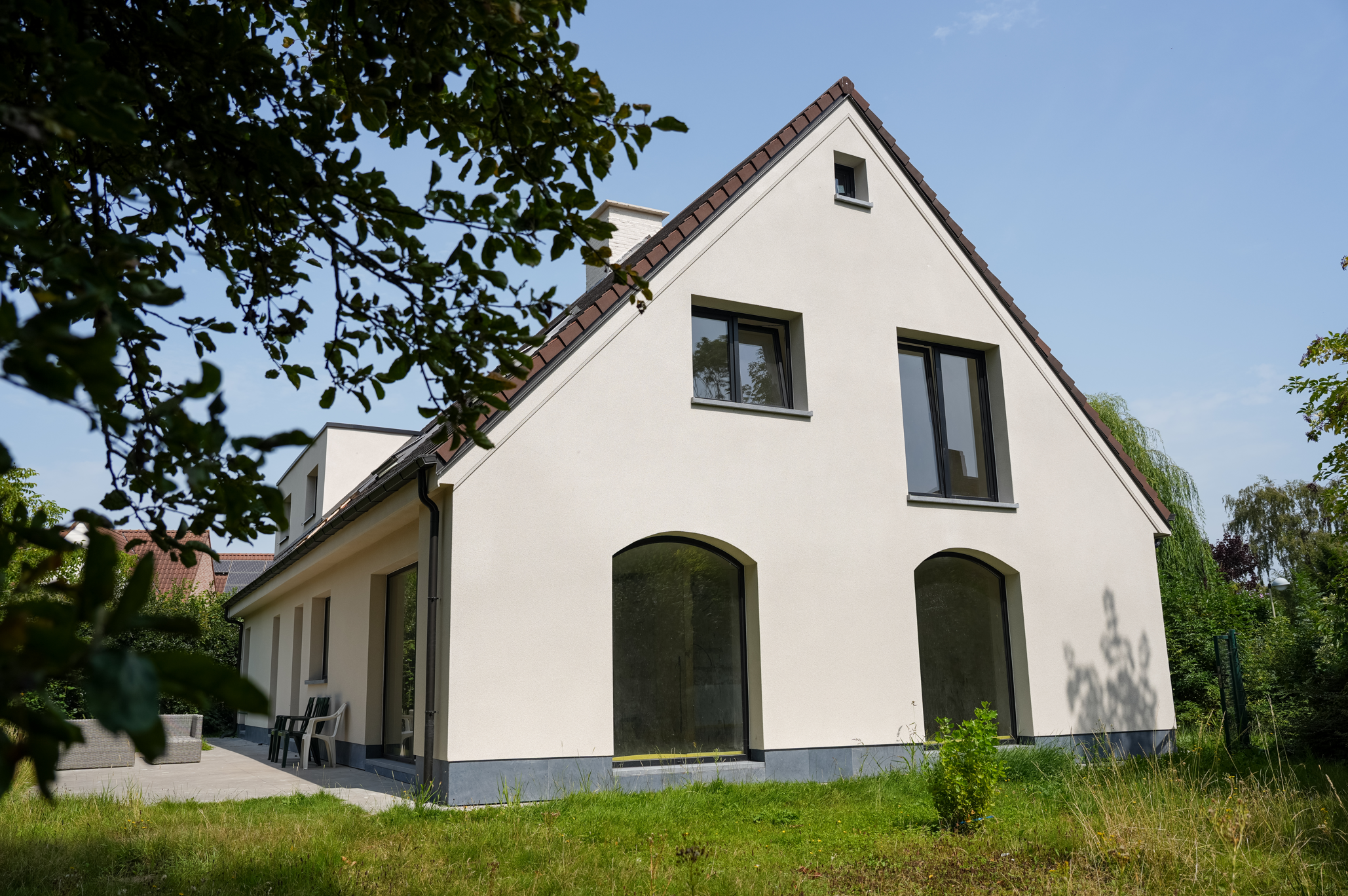
Complying with the 2050 insulation standard
To achieve the climate goals, we all need to consume less energy. One of the key measures is to make our homes more energy-efficient. The Flemish government is determined to make our buildings future-proof. The insulation of your home’s outer shell plays an important role in this.
To comply with the 2050 energy targets, it is enough to meet one of these two conditions.
1. Energy-efficient components
The first option is to look separately at all the factors that influence your energy consumption. For this, the Flemish government has set out a number of rules.
- Your home must be equipped with an energy-efficient heating system. Examples include a heat pump, a condensing boiler, a micro-CHP (combined heat and power), a connection to a district heating network, or decentralized appliances with a total maximum capacity of 15 W/m².
- The building components of your home must meet these maximum U-values:
- roofs, floors and walls: 0.24
- glazing: 1.0, and glazing plus window frames combined: 1.5
- doors and gates: 2.0
A quick technical explanation: the U-value is the thermal transmittance coefficient, expressed in W/(m²K). It indicates how many Watts (W) pass through your construction per second, per square metre (m²), and per degree of temperature difference (K). In the past, people sometimes referred to the k-value. For windows, the Uw (for window) equals the Ug (for glass) plus the Uf (for frame).
The lower the U-value, the less heat is lost and the more energy-efficient your home is. Insulation material, particularly its thickness and insulating performance, has the greatest impact on the U-value. That’s why, for insulation works, we choose 12-centimetre PIR panels, which easily comply with the government’s requirements.

2. A or A+ label
Does one of your home’s components have a higher U-value, or do you not yet have a sustainable heating system? Then it is still possible to comply with the 2050 standards with an EPC label of A or A+. This means that, in its current state, your EPC score is a maximum of 100 kWh/m². If you are building a new home or carrying out a major energy renovation, the maximum E-level in your EPB declaration must be E60.
Energieprestatiecertificaat versus Energieprestatie en Binnenklimaat
An important indicator for the 2050 insulation standard is the Energy Performance Certificate (EPC). With your EPC score, you must comply with the EPB requirements for Energy Performance and Indoor Climate. Both your EPC score and your E-level are calculations of how much energy your home consumes. Several factors are taken into account:
- the insulation values of your roofs, exterior walls, floors, windows, doors, and gates
- the energy efficiency of your heating installations
- the airtightness and ventilation of your home
Cleys tip: are you renting or buying a home? Then the seller is obliged to provide you with an EPC. In it, you’ll find not only the score of your new home, but also various suggestions for improving its energy efficiency.
Renovation obligation and insulation standards
An Energy Performance Certificate (EPC) assigns a label to a building. It indicates how much energy your home consumes annually, expressed in kilowatt-hours per square metre.
- EPC A+: less than 0 kWh/m²
- EPC A: between 0 and 100 kWh/m²
- EPC B: between 100 and 200 kWh/m²
- EPC C: between 200 and 300 kWh/m²
- EPC D: between 300 and 400 kWh/m²
- EPC E: between 400 and 500 kWh/m²
- EPC F: more than 500 kWh/m²
Since 2023, buyers of a home with an E or F label are obliged to upgrade their new property to at least label D within 5 years. This renovation obligation will gradually be raised over the coming years, so that in theory, by 2045, all Flemish homes will have an A or A+ label.
- from 2023: from E or F to D within 5 years
- from 2028: from D, E or F to C within 5 years
- from 2035: from C, D, E or F to B within 5 years
- from 2040: from B, C, D, E or F to A within 5 years
Cleys tip: in 2024, only 1% of single-family houses and 6% of apartments in Flanders have an A label. So there is still plenty of work to do - and we are happy to contribute. With these energy upgrades, you can improve your score:
- Insulating the façade: when installing new cladding, immediately choose exterior wall insulation for less heat loss and greater comfort.
- Insulating the roof: with a roof renovation - Cleys is an expert in both flat and pitched roofs - you thoroughly and efficiently address one of the largest exterior surfaces of your home.
- Insulating windows and doors: pay special attention to the access points of your home, where a lot of heat or cold may escape.
Are you the owner or another investor of a building older than 15 years in the Flemish region? Then you are entitled to a grant for insulating your external walls if the insulating materials have an R or Rd value (measure of thermal insulation) of at least 3 m²K/W. The exact amount depends, among other things, on the quoted price, but it can be estimated using the Mijn VerbouwPremie simulator.
Get your home ready for 2050
The name says it all: the renovation obligation is mandatory. The insulation standard for 2050 is not (yet). Still, experts like Cleys always recommend at least taking it into account - and preferably meeting it. This way, you enjoy three concrete benefits:
- You help achieve energy goals and address climate issues.
- You benefit from lower energy bills and greater living comfort.
- Your home increases in value and becomes more attractive on the property market.
Cleys tip: a potential obstacle to energy improvements is the high cost. The government supports you with financial aid, and banks also lend a helping hand. Discover everything about grants and loans for insulation.
Questions about the 2050 insulation standards?
Cleys is an expert in renovating the entire exterior shell of your home, from the doors on the ground floor to the very top of your roof. For us, renovation always goes hand in hand with insulation. We ensure not only an aesthetically appealing result but also an energy-efficient one.
Ready to make sure your home is prepared for 2050 and beyond? Book an appointment with one of our experts and fire away all your questions about renovation and insulation. Together, we’ll lower your energy bill and reduce your ecological footprint.